
| BIOGRAPHY THE DESIGN PROCESS PLANTING |
 |
|
 |
|
 |
|
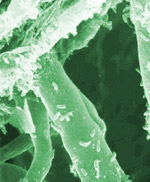 |
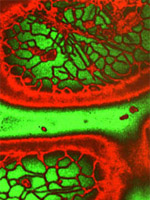
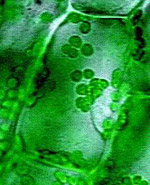
| Plant cells |
Nature is a huge source of inspiration in our work. In nature even the smallest leaf has an ordered structure. Although it appears to be a random effect it is held together with an underlying strength in shape, design, balance, proportion, scale, and abstraction. There is a fine balance between order and chaos in the surrounding landscape and with this nature shows us a beauty and energy that we can harness within the garden.
Even the smallest gardens need a considered structure to hold together the design. Beauty can be prescribed in these man made spaces by focussing on the process of design and construction, and exploiting the potential of materials. It is important to have an eye for detail and practicality whilst being able to stand back and look at the wider picture. There are elements to consider in a garden such as the relationship of the house with the outside space and the integration of the garden with the wider landscape.
Gardens ultimately represent people in all their diversity. These small humanised spaces are like the cells of the earth, small islands where we can aspire to understand the system of things on a much wider scale Gardens should ultimately inspire reflection and create a place where function and philosophy and man and nature can meet.
The essence of The Earth's beauty lies in disorder, a peculiarly patterned disorder, from the fierce tumult of rushing water to the tangled filigrees of unbridled vegetation. ' James Gleick, 'Nature's Chaos'
BIOGRAPHY
Natalie Dewsnap studied Creative Arts at the University of Northumbria at Newcastle after which she completed a postgraduate diploma in Garden Design at The Oxford College of Garden Design.
She has worked as an artist within schools involved in relandscaping schemes for playgrounds such as 'Learning Through Landscapes' and has extensive horticultural knowledge from working in various garden nurseries specialising in a wide range of trees, shrubs and perennials.
Since studying at the Oxford College of Garden Design she has worked as a freelance designer to Gardening Which? Magazine and within garden design practices in London as a design assistant, to Christopher Bradley-Hole Ltd and as part of the garden construction team at Sallis Chandler Ltd.
In 1998 she set up Dewsnap Garden Design first in Glasgow, Scotland and then in London and the South West providing an exterior design service for private and commercial gardens and outdoor spaces.
Television:
Catalyst Television- 2002
Pilot film with Joe Swift & Catherine Cutler for a new BBC Interactive garden series
London Weekend Television- June 2001
Border Patrol (6 episodes) Co-presenter with Carl Wild. garden design solutions and gardening tips
Catalyst Television- April 2000
Presenter, pilot film for BBC Gardener's World
GranadaTelevision- March 2000
Homes and Gardens Livetime. Garden design presenter. Granada Breeze)-
Published work:
The Garden Design Journal, June 2000 and May 2000,
Your Garden Magazine, March 2000
Gardening Which? Magazine August 1998, showing simple design principles to help members transform their gardens.
THE DESIGN PROCESS
After obtaining as much information as possible from the existing site and translating this onto a scaled plan the designing process itself can be a liberating experience. It allows you to stand back, look at the bare bones of the garden and the elements you have to work with and experiment with ideas, shapes, forms and patterns before committing to a final design.
Working designs through from flat two dimensional plans to three dimensional projections and construction drawings help to visualise the finished design and enable the garden to be built exactly to the plan.
PLANTING
Planting is vital to the structure, design and atmosphere in many gardens in order that the space does not become a static monument. The planting brings the garden alive and makes it a living sculpture. It is the spontaneous, unpredictable and chaotic element in the design which continually redefines the space and ensures it is always evolving.
In order to work with the ecology of the site it makes sense to choose plants that will suit the particular conditions. By looking at nature we can see which plants will thrive or tolerate a situation and by working with the conditions of the site instead of against it is possible to capture some of nature's energy and spirit.
Some of the most exciting designs come from simplicity and strength in design balanced with the wildness of nature. It is this wildness which challenges the idea that a site is a fixed a place.